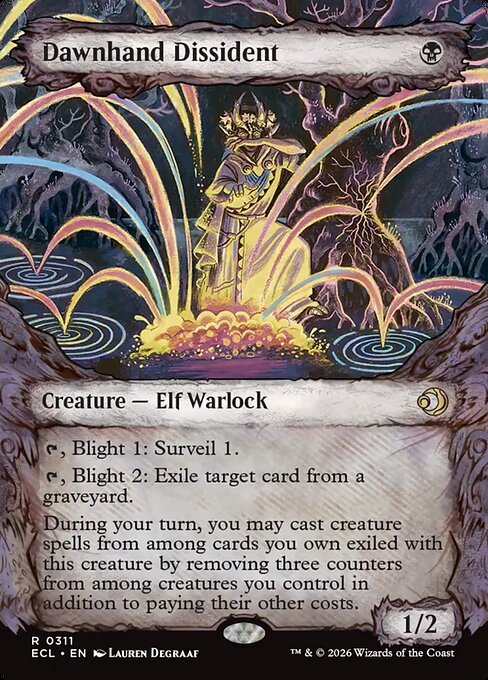
Dawnhand Dissident
—Views
—Likes
—Times played


- Card type
- Creature — Elf Warlock
- Rarity
- Rare
Non-foil
0.50 €
Falling
Foil
0.61 €
Falling
Non-foil
0.35 $
Stable
Foil
0.41 $
Rising
- Mana value
- 1
- Power
- 1
- Toughness
- 2
- Colour
- Black
Card text
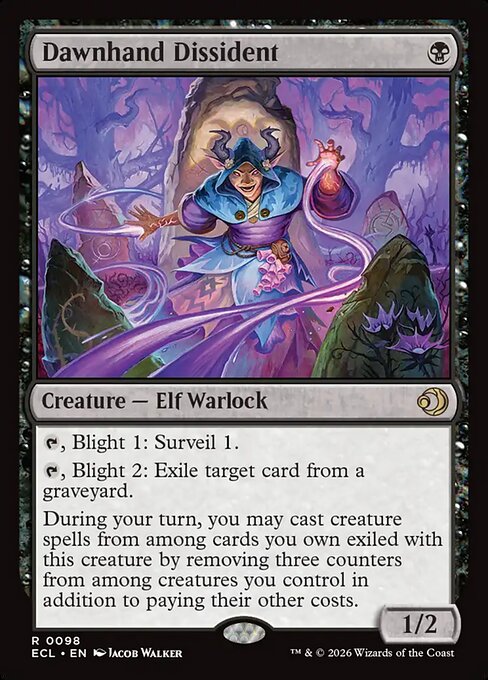
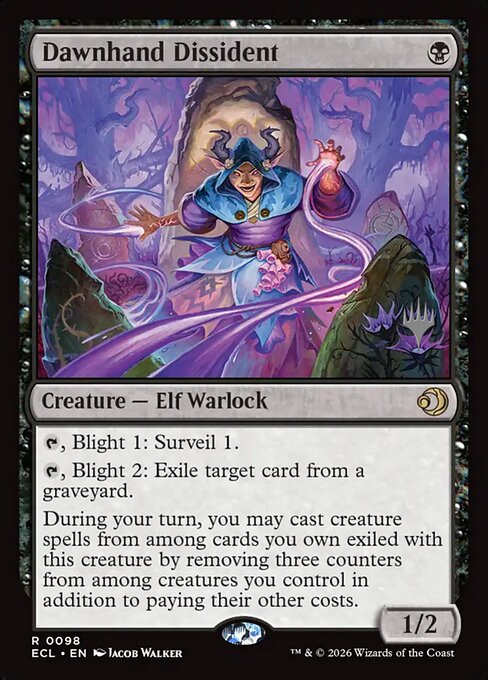
, Blight 1: Surveil 1. , Blight 2: Exile target card from a graveyard. During your turn, you may cast creature spells from among cards you own exiled with this creature by removing three counters from among creatures you control in addition to paying their other costs.
Format legality
- CommanderLegal
- Duel CommanderLegal
- Pauper CommanderNot provided
- StandardLegal
- PioneerLegal
- ModernLegal
- LegacyLegal
- VintageLegal
- PauperNot provided
- AlchemyLegal
- BrawlLegal
- Competitive BrawlLegal
- Historic BrawlNot provided
- Standard BrawlLegal
- ExplorerNot provided
- HistoricLegal
- TimelessLegal
- GladiatorLegal
- OathbreakerLegal
- Old SchoolNot provided
- Penny DreadfulLegal
- PreDHNot provided
- PremodernNot provided
- Tiny Leaders RebornNot provided
- Future StandardLegal
Updated on
Play this card in a deck
Add Dawnhand Dissident to a deck that fits your table’s format to play Magic online on MainTable.
Build a Magic deck and play with it
Find an online Magic tablePrinting information
- Illustrator
- Jacob Walker
- Card language
- English
- Release date
- 2026-01-23
Rulings
All of the -1/-1 counters must be put on a single creature. You can't choose to split them up between multiple creatures.
Dawnhand Dissident must be under your control in order for you to start casting a creature spell using its last ability, but it doesn't need to stay under your control throughout that process or be under your control as the spell resolves. If, for example, you sacrifice Dawnhand Dissident to pay an additional cost of the spell or it's destroyed in response, the spell will still resolve normally.
If a creature has +1/+1 counters and -1/-1 counters on it, state-based actions remove the same number of each so that it has only one kind of those counters on it. For example, if a creature has three +1/+1 counters on it and two -1/-1 counters are put on it, state-based actions will remove two of each of those kinds of counters, leaving the creature with just one +1/+1 counter.
If a creature that has +1/+1 counters on it receives enough -1/-1 counters to cause it to be destroyed by lethal damage or put into its owner's graveyard for having 0 or less toughness, effects that refer to the counters on that creature when it died will see all of those +1/+1 and -1/-1 counters.
If you can't place -1/-1 counters on any creatures you control (probably because you control no creatures), you can't choose to blight.
Once you've announced that you're casting a spell or activating an ability, players can't take actions until you've finished doing so. Notably, opponents can't try to destroy or otherwise remove your creatures to stop you from blighting as part of paying the cost of that spell or ability.
The creature you choose to put -1/-1 counters on doesn't have to have enough toughness to survive the process. For example, if you blight 2, you can choose to put the counters on a 1/1 creature you control.
You must still pay all costs and follow any timing restrictions and permissions for creature spells you cast from exile this way. Normally, you'll be able to cast them only during your main phase while the stack is empty.
Other printings of this card
Newest first · includes artwork variants.
Indicative price history
Indicative Scryfall prices for this printing. EUR and USD reflect different markets, without conversion. Dates reflect actual recorded observations.
Show accessible observations
| Observation date | Finish | Price |
|---|
Combos involving this card
Combinations from Commander Spellbook. Check prerequisites, format legality and game context. Source conditions are in English.