At Knifepoint


- Card type
- Enchantment
- Rarity
- Uncommon
- Mana value
- 3
- Colour
- Black Red
Card text
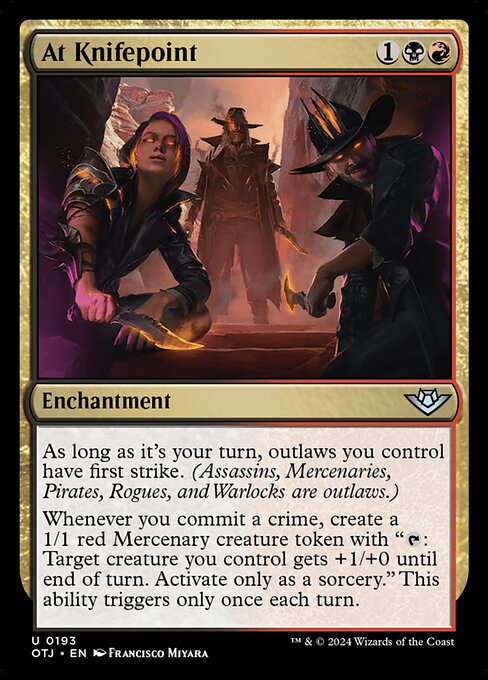
During your turn, outlaws you control have first strike. (Assassins, Mercenaries, Pirates, Rogues, and Warlocks are outlaws.) Whenever you commit a crime, create a 1/1 red Mercenary creature token with ": Target creature you control gets +1/+0 until end of turn. Activate only as a sorcery." This ability triggers only once each turn.
Format legality
- CommanderLegal
- Duel CommanderLegal
- Pauper CommanderNot provided
- StandardLegal
- PioneerLegal
- ModernLegal
- LegacyLegal
- VintageLegal
- PauperNot provided
- AlchemyNot provided
- BrawlLegal
- Competitive BrawlLegal
- Historic BrawlNot provided
- Standard BrawlLegal
- ExplorerNot provided
- HistoricLegal
- TimelessLegal
- GladiatorLegal
- OathbreakerLegal
- Old SchoolNot provided
- Penny DreadfulNot provided
- PreDHNot provided
- PremodernNot provided
- Tiny Leaders RebornNot provided
- Future StandardNot provided
Updated on
Play this card in a deck
Add At Knifepoint to a deck that fits your table’s format to play Magic online on MainTable.
Build a Magic deck and play with it
Find an online Magic tablePrinting information
- Illustrator
- Francisco Miyara
- Card language
- English
- Release date
- 2024-04-19
Rulings
A card, spell, or permanent is an outlaw if it has the Assassin, Mercenary, Pirate, Rogue, or Warlock creature type. It doesn’t matter if it has more than one of those creature types; as long as it has at least one, it’s an outlaw.
A player can commit only one crime per spell or ability they control. Targeting multiple opponents, permanents, spells, abilities, and/or cards with the same spell or ability doesn’t constitute committing multiple crimes.
A player commits a crime as they cast a spell, activate an ability, or put a triggered ability on the stack that targets at least one opponent, at least one permanent, spell, or ability an opponent controls, and/or at least one card in an opponent’s graveyard.
Changing the target or targets of a spell or ability won’t affect whether or not the controller of that spell or ability has committed a crime. Only the initial targets chosen for that spell or ability are used to determine whether or not its controller committed a crime.
Creatures that deal first strike combat damage but lose first strike before regular combat damage is dealt won’t deal combat damage again unless they have double strike. This means you can’t have At Knifepoint leave the battlefield to have your outlaws deal combat damage twice in a turn.
For example, an ability that triggers when you cast a spell that targets an opponent will trigger at the same time as an ability that triggers whenever you commit a crime. Those abilities can be put on the stack in either order (if you control them both), and they’ll both resolve before the spell that caused them to trigger.
If an ability refers to an outlaw or whether a player controls an outlaw, it’s referring only to permanents with one or more of the creature types specified above. Notably, it’s not referring to any spell or card not on the battlefield. However, other abilities may refer to an “outlaw spell” or “outlaw card” in a zone other than the battlefield. Those abilities refer to spells and cards with one or more of the specified creature types.
Outlaw is not a creature type. If an effect asks you to choose a creature type, you can’t choose outlaw.
The spell or ability that constituted a crime doesn’t have to have resolved yet or at all. As soon as you’re finished casting the spell, activating the ability, or putting the triggered ability on the stack, you’ve committed a crime.
Other printings of this card
Newest first · includes artwork variants.
Indicative price history
Indicative Scryfall prices for this printing. EUR and USD reflect different markets, without conversion. Dates reflect actual recorded observations.
Show accessible observations
| Observation date | Finish | Price |
|---|
Combos involving this card
Combinations from Commander Spellbook. Check prerequisites, format legality and game context. Source conditions are in English.