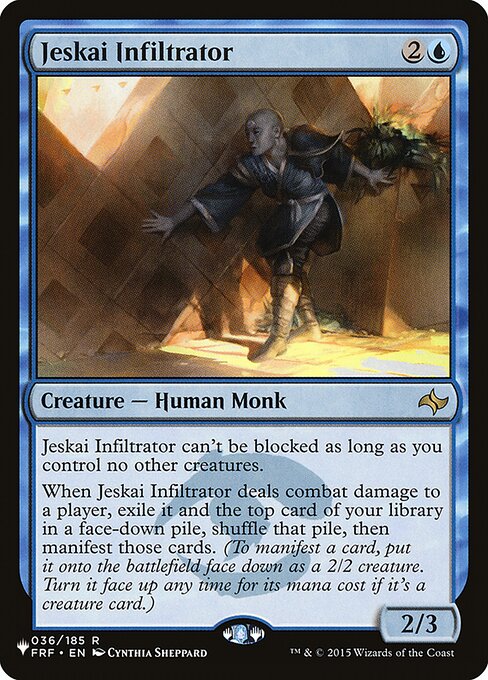
Infiltratrice jeskaï
—Vues
—J’aime
—Cartes jouées

- Type de carte
- Créature : humain et moine
- Rareté
- Rare
Non-foil
0,12 €
En hausse
Foil
0,28 €
Stable
Non-foil
0,19 $
Stable
Foil
0,43 $
Stable
- Valeur de mana
- 3
- Force
- 2
- Endurance
- 3
- Couleur
- Bleu
Texte de la carte
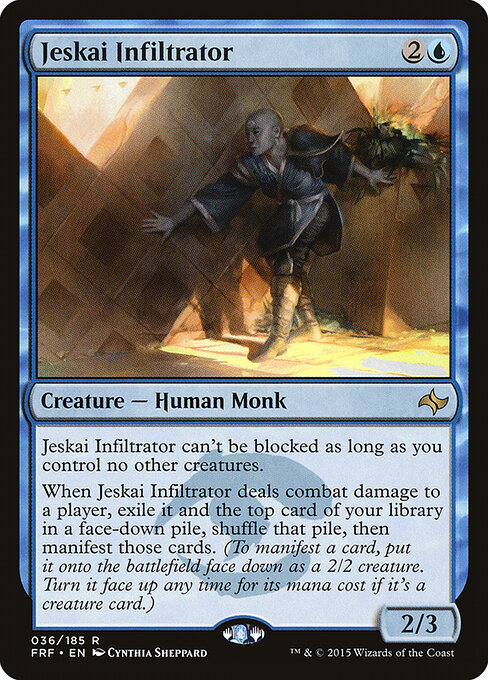
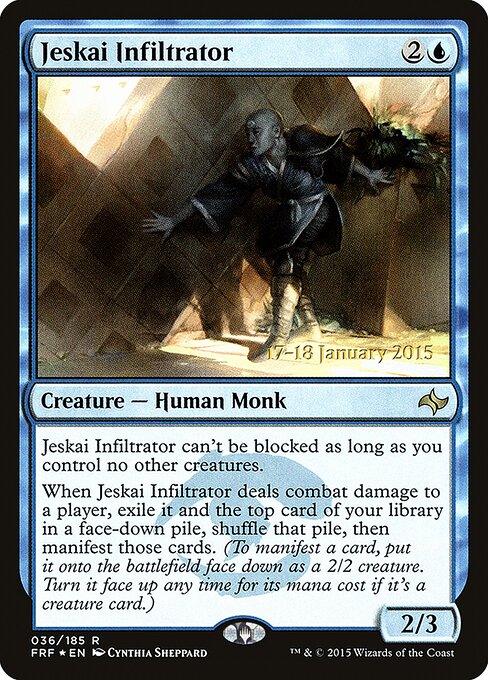
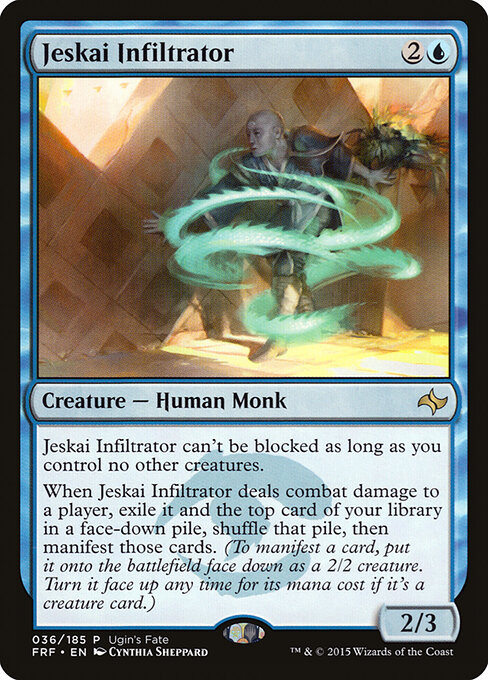
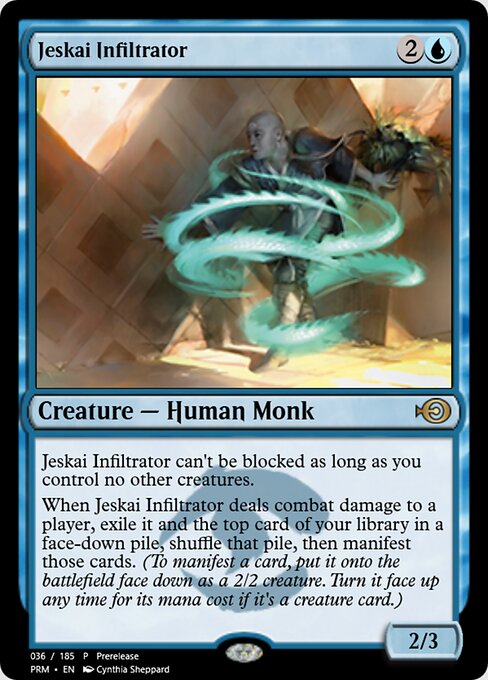
L'Infiltratrice jeskaï ne peut pas être bloquée tant que vous ne contrôlez pas d'autre créature. Quand l'Infiltratrice jeskaï inflige des blessures de combat à un joueur, exilez-la ainsi que la carte du dessus de votre bibliothèque dans un tas face cachée, mélangez-le, puis manifestez ces cartes. (Pour manifester une carte, mettez-la sur le champ de bataille face cachée comme une créature 2/2. Retournez-la face visible à tout moment pour son coût de mana si c'est une carte de créature.)
Texte original anglais (Oracle)
Texte français imprimé sur la carte. En cas de doute, le texte Oracle anglais fait référence pour les règles.
This creature can't be blocked as long as you control no other creatures. When this creature deals combat damage to a player, exile it and the top card of your library in a face-down pile, shuffle that pile, then manifest those cards. (To manifest a card, put it onto the battlefield face down as a 2/2 creature. Turn it face up any time for its mana cost if it's a creature card.)
Légalité par format
- CommanderAutorisée
- Duel CommanderAutorisée
- Pauper CommanderNon renseignée
- StandardNon renseignée
- PioneerAutorisée
- ModernAutorisée
- LegacyAutorisée
- VintageAutorisée
- PauperNon renseignée
- AlchemyNon renseignée
- BrawlNon renseignée
- Competitive BrawlNon renseignée
- Historic BrawlNon renseignée
- Standard BrawlNon renseignée
- ExplorerNon renseignée
- HistoricNon renseignée
- TimelessNon renseignée
- GladiatorNon renseignée
- OathbreakerAutorisée
- Old SchoolNon renseignée
- Penny DreadfulAutorisée
- PreDHNon renseignée
- PremodernNon renseignée
- Tiny Leaders RebornNon renseignée
- Future StandardNon renseignée
Mis à jour le
Jouer cette carte dans un deck
Ajoutez Infiltratrice jeskaï à un deck compatible avec le format de votre table pour jouer à Magic en ligne sur MainTable.
Créer un deck Magic et jouer avec
Trouver une table de Magic en ligneInformations sur cette impression
- Illustration
- Cynthia Sheppard
- Langue de la carte
- English
- Date de sortie
- 2015-01-23
Précisions de règles
A card's owner is public information at all times. If the two cards you exile are owned by different players (perhaps because you gained control of a Jeskai Infiltrator owned by your opponent), which card is which is no longer hidden from your opponent. That player will know which face-down creature they own.
A permanent that turns face up or face down changes characteristics but is otherwise the same permanent. Spells and abilities that were targeting that permanent, as well as Auras and Equipment that were attached to the permanent, aren't affected.
Any time you have priority, you may turn a manifested creature face up by revealing that it's a creature card (ignoring any copy effects or type-changing effects that might be applying to it) and paying its mana cost. This is a special action. It doesn't use the stack and can't be responded to.
At any time, you can look at a face-down permanent you control. You can't look at face-down permanents you don't control unless an effect allows you to or instructs you to.
Because face-down creatures don't have names, they can't have the same name as any other creature, even another face-down creature.
Because the permanent is on the battlefield both before and after it's turned face up, turning a permanent face up doesn't cause any enters-the-battlefield abilities to trigger.
If Jeskai Infiltrator isn't on the battlefield as its triggered ability resolves, you'll manifest just the top card of your library.
If a double-faced card is manifested, it will be put onto the battlefield face down. While face down, it can't transform. If the front face of the card is a creature card, you can turn it face up by paying its mana cost. If you do, its front face will be up.
If a face-down permanent you control leaves the battlefield, you must reveal it. You must also reveal all face-down spells and permanents you control if you leave the game or if the game ends.
If a manifested creature would have morph if it were face up, you may also turn it face up by paying its morph cost.
If you manifest a card owned by an opponent and you leave the game, that card is exiled.
The face-down permanent is a 2/2 creature with no name, mana cost, creature types, or abilities. It's colorless and has a mana value of 0. Other effects that apply to the permanent can still grant or change any of these characteristics.
The pile is shuffled to disguise from your opponents which manifested creature is which. After you manifest the cards, you can look at them.
There are no cards in the Fate Reforged set that would turn a face-down instant or sorcery card on the battlefield face up, but some older cards can try to do this. If something tries to turn a face-down instant or sorcery card on the battlefield face up, reveal that card to show all players it's an instant or sorcery card. The permanent remains on the battlefield face down. Abilities that trigger when a permanent turns face up won't trigger, because even though you revealed the card, it never turned face up.
Turning a permanent face up or face down doesn't change whether that permanent is tapped or untapped.
Unlike a face-down creature that was cast using the morph ability, a manifested creature may still be turned face up after it loses its abilities if it's a creature card.
You must ensure that your face-down spells and permanents can easily be differentiated from each other. You're not allowed to mix up the cards that represent them on the battlefield in order to confuse other players. The order they entered the battlefield should remain clear. Common methods for indicating this include using markers or dice, or simply placing them in order on the battlefield. You must also track how each became face down (manifested, cast face down using the morph ability, and so on).
A permanent that turns face up or face down changes characteristics but is otherwise the same permanent. Spells and abilities that were targeting that permanent, as well as Auras and Equipment that were attached to the permanent, aren't affected.
Any time you have priority, you may turn a manifested creature face up by revealing that it's a creature card (ignoring any type-changing effects that might be applying to it) and paying its mana cost. This is a special action. It doesn't use the stack and can't be responded to.
At any time, you can look at a face-down permanent you control. You can't look at face-down permanents you don't control unless an effect instructs you to do so.
Because face-down creatures don't have a name, they can't have the same name as any other creature or share any creature types with any other creature, even another face-down creature.
Because the permanent is on the battlefield both before and after it's turned face up, turning a permanent face up doesn't cause any enters-the-battlefield abilities to trigger.
If a face-down permanent you control leaves the battlefield, you must reveal it. You must also reveal all face-down spells and permanents you control if you leave the game or if the game ends.
If an effect tries to return a face-down creature to the battlefield after it leaves (such as Aminatou's second ability or Adarkar Valkyrie's delayed triggered ability), that effect returns the card face up. If it tries to put an instant or sorcery card onto the battlefield this way, that card remains in its current zone instead.
Some previous Magic sets feature double-faced cards, which have a Magic card face on each side rather than a Magic card face on one side and a Magic card back on the other. If a double-faced card is manifested, it will be put onto the battlefield face down. While face down, it can't transform. If the front face of the card is a creature card, you can turn it face up by paying its mana cost. If you do, its front face will be up. Although a double-faced card can enter the battlefield face down, one already on the battlefield can't be turned face down.
The face-down characteristics of a permanent are copiable values. If another object becomes a copy of a face-down creature or if a token is created that's a copy of a face-down creature, that new object is a 2/2 colorless face-up creature with no abilities.
The face-down permanent is a 2/2 creature with no name, mana cost, creature types, or abilities. It's colorless and has a mana value of 0. Other effects that apply to the permanent can still grant or change any of these characteristics.
There are no cards in this set that would turn a face-down instant or sorcery card on the battlefield face up, but some older cards can try to do this. If something tries to turn a face-down instant or sorcery card on the battlefield face up, reveal that card to show all players it's an instant or sorcery card. The permanent remains on the battlefield face down. Abilities that trigger when a permanent turns face up won't trigger, because even though you revealed the card, it never turned face up.
Turning a permanent face up or face down doesn't change whether that permanent is tapped or untapped.
You must ensure that your face-down spells and permanents can easily be differentiated from each other. You're not allowed to mix up the cards that represent them on the battlefield to confuse other players. The order they entered the battlefield should remain clear. Common methods for indicating this include using markers or dice, or simply placing them in order on the battlefield. You must also track how each became face down (manifested, cast face down using a morph ability, and so on).
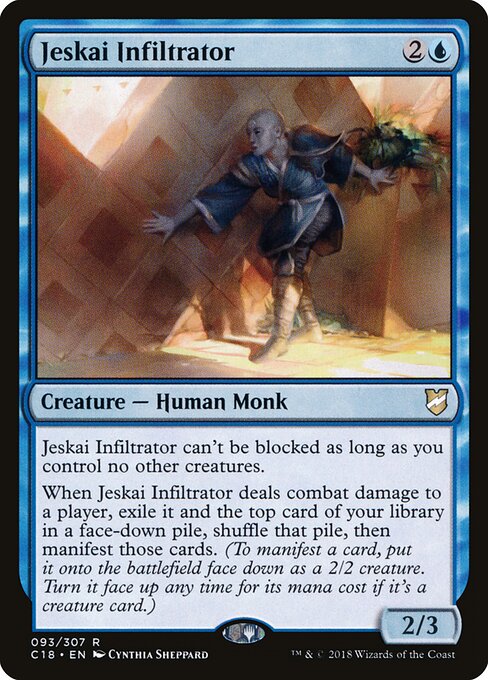
Autres impressions de cette carte
De la plus récente à la plus ancienne · illustrations et variantes incluses.
Historique des prix indicatifs
Prix indicatifs Scryfall de cette impression. EUR et USD représentent des marchés différents, sans conversion. Les dates reflètent les relevés réellement enregistrés.
Afficher les relevés accessibles
| Date du relevé | Finition | Prix |
|---|
Combos liés à cette carte
Combinaisons issues de Commander Spellbook. Les prérequis, la légalité du format et la situation de jeu restent à vérifier. Les textes source des conditions sont en anglais.