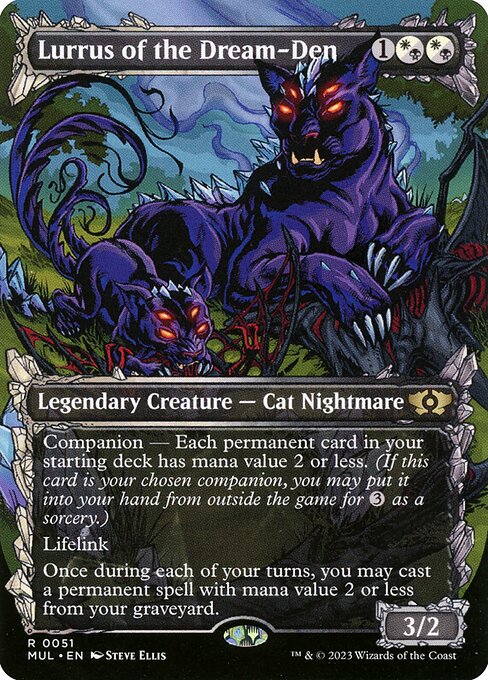
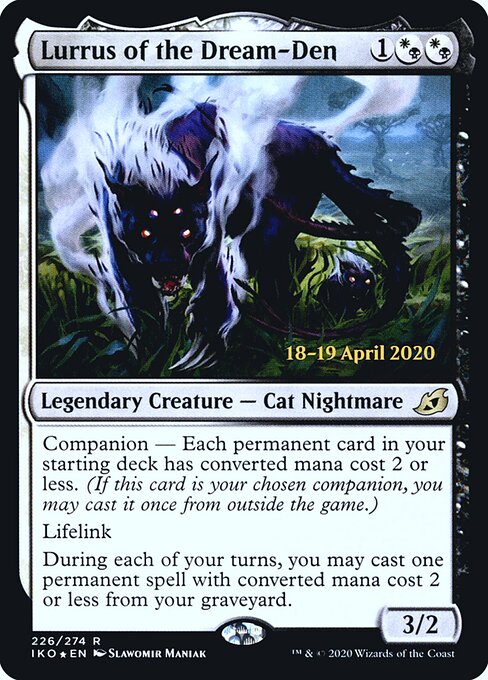
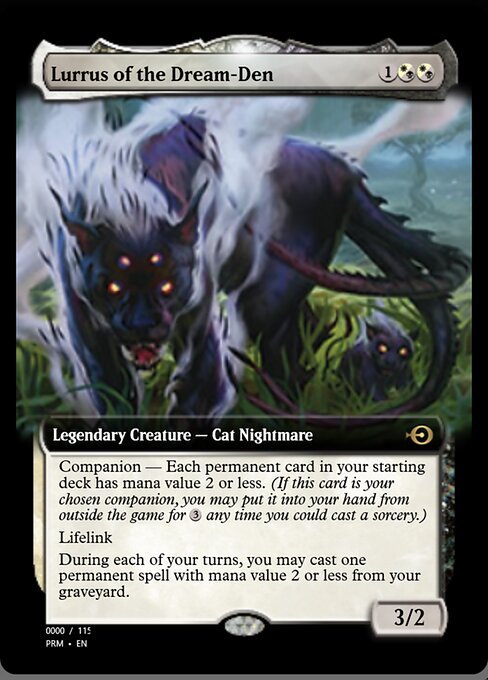
Lurrus de la Tanière des rêves
—Vues
—J’aime
—Cartes jouées


- Type de carte
- Créature légendaire : chat et cauchemar
- Rareté
- Rare
Foil
449,10 €
Stable
Foil
Prix indisponible
- Valeur de mana
- 3
- Force
- 3
- Endurance
- 2
- Couleur
- Blanc Noir
Texte de la carte
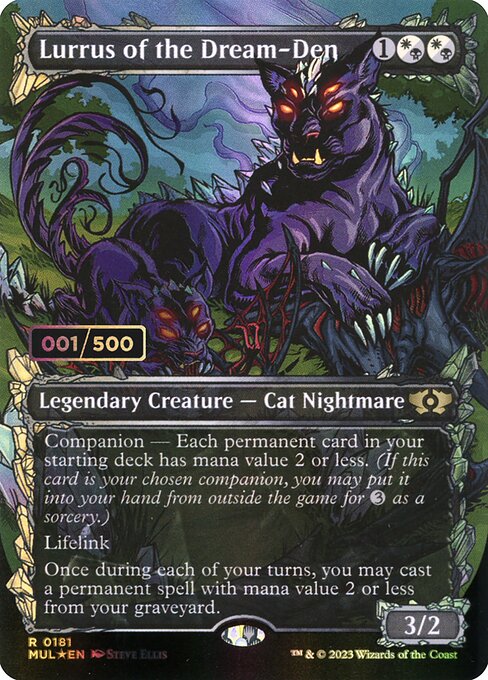
Compagnon — Chaque carte de permanent de votre deck de départ a une valeur de mana inférieure ou égale à 2. (Si cette carte est le compagnon de votre choix, vous pouvez la mettre dans votre main depuis l'extérieur de la partie pour lorsque vous pourriez lancer un rituel.) Lien de vie Une fois pendant chacun de vos tours, vous pouvez lancer un sort de permanent d'une valeur de mana inférieure ou égale à 2 depuis votre cimetière.
Texte original anglais (Oracle)
Texte français imprimé sur la carte. En cas de doute, le texte Oracle anglais fait référence pour les règles.
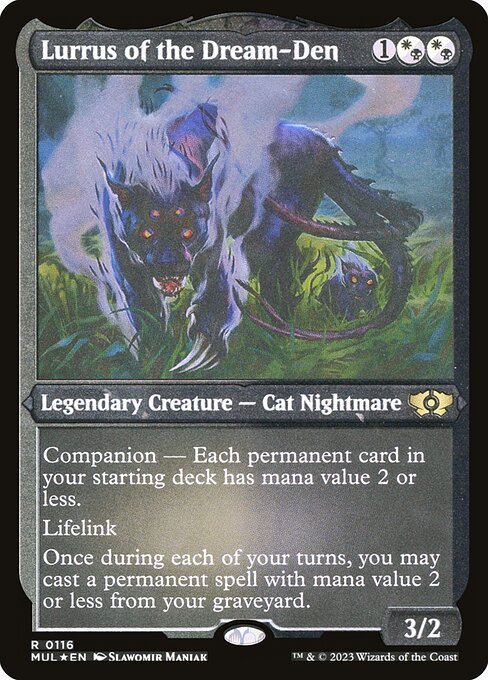
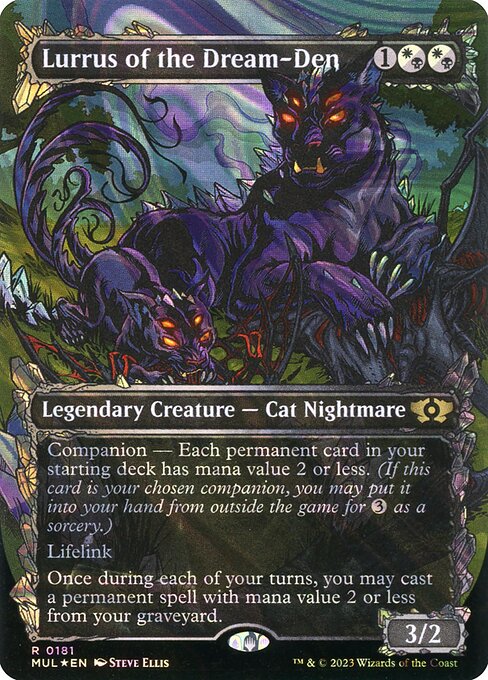
Companion — Each permanent card in your starting deck has mana value 2 or less. (If this card is your chosen companion, you may put it into your hand from outside the game for as a sorcery.) Lifelink Once during each of your turns, you may cast a permanent spell with mana value 2 or less from your graveyard.
Légalité par format
- CommanderAutorisée
- Duel CommanderAutorisée
- Pauper CommanderNon renseignée
- StandardNon renseignée
- PioneerInterdite
- ModernInterdite
- LegacyInterdite
- VintageAutorisée
- PauperNon renseignée
- AlchemyNon renseignée
- BrawlAutorisée
- Competitive BrawlAutorisée
- Historic BrawlNon renseignée
- Standard BrawlNon renseignée
- ExplorerNon renseignée
- HistoricAutorisée
- TimelessAutorisée
- GladiatorAutorisée
- OathbreakerAutorisée
- Old SchoolNon renseignée
- Penny DreadfulAutorisée
- PreDHNon renseignée
- PremodernNon renseignée
- Tiny Leaders RebornNon renseignée
- Future StandardNon renseignée
Mis à jour le
Jouer cette carte dans un deck
Ajoutez Lurrus de la Tanière des rêves à un deck compatible avec le format de votre table pour jouer à Magic en ligne sur MainTable.
Créer un deck Magic et jouer avec
Trouver une table de Magic en ligneInformations sur cette impression
- Illustration
- Steve Ellis
- Langue de la carte
- English
- Date de sortie
- 2023-04-21
Précisions de règles
Before shuffling your deck to become your library, you may reveal one card from outside the game to be your companion if your starting deck meets the requirements of the companion ability. You can't reveal more than one. It remains revealed outside the game as the game begins.
For spells with in their mana costs, use the value chosen for X to determine the spell's mana value. For example, if a permanent spell costs , you could cast it with X as 1 but not as 2.
If a card in a player's deck has in its mana cost, X is considered to be 0.
If a permanent card is put into your graveyard during your main phase and the stack is empty, you have a chance to cast it before any player may attempt to remove that card from your graveyard.
If more than one player wishes to reveal a companion, the starting player does so first, and players proceed in turn order. Once a player has chosen not to reveal a companion, that player can't change their mind.
If you cast a spell from your graveyard using another permission, Lurrus's effect doesn't apply. You can cast another permanent spell from your graveyard.
If you cast one permanent spell from your graveyard and then have a new Lurrus come under your control in the same turn, you may cast another permanent spell from your graveyard that turn.
If you reveal a companion outside the game, for as long as it remains there, you may pay any time you could cast a sorcery (that is, you have priority during your main phase and the stack is empty). Once you do, you put it into your hand and behaves like any other card you've brought into the game. For example, if it's discard, countered, or destroyed, it's put into your graveyard, remaining in the game. This is a change from previous rules.
Lurrus doesn't care about instant and sorcery cards in your starting deck. They may have any mana value.
Lurrus doesn't let you play lands from your graveyard.
Once you begin to cast the spell, losing control of Lurrus won't affect the spell. You can finish casting it as normal.
Paying to put your companion into your hand is a special action. It doesn't use the stack and players can't respond to it. Once you take this action, you may cast that card if it's legal to do so before any other player can take actions.
The companion ability has no effect if the card is in your starting deck and creates no restriction on putting a card with a companion ability into your starting deck. For example, Zirda may be in your starting deck even if your other permanent cards don't all have activated abilities.
The companion's other abilities apply only if the creature is on the battlefield. They have no effect while the companion is outside the game.
The requirements of the companion ability apply only to your starting deck. They do not apply to your sideboard.
You may have one companion in the Commander variant. Your deck, including your commander, must meet its companion requirement. Your companion is not one of your one hundred cards.
You must follow the normal timing permissions and restrictions of the spell you cast from your graveyard.
You must pay the costs to cast that spell. If it has an alternative cost, such as a mutate cost, you may cast it for that cost instead.
Your companion begins the game outside the game. In tournament play, this means your sideboard. In casual play, it's simply a card you own that's not in your starting deck.
If you reveal a companion outside the game, for as long as it remains there, you may pay any time you could cast a sorcery (that is, you have priority during your main phase and the stack is empty). Once you do, you put it into your hand and behaves like any other card you've brought into the game. For example, if it's discarded, countered, or destroyed, it's put into your graveyard, remaining in the game. This is a change from previous rules.
Once you put your companion into your hand, it behaves like any other card you’ve brought into the game. For example, if it’s countered or destroyed, it’s put into your graveyard, remaining in the game.
Paying to put your companion into your hand is a special action. It doesn't use the stack and players can't respond to it. Once you take this action, you may cast that card if it's legal to do so before any other player can take actions.
Wizards of the Coast has issued functional errata for the Companion mechanic. Instead of casting companions from outside the game: Once per game, any time you could cast a sorcery (during your main phase when the stack is empty), you can pay to put your companion from your sideboard into your hand. This is a special action, not an activated ability. It happens immediately and can’t be responded to. It can’t be countered or stopped by cards like Phyrexian Revoker. For more information please see https://magic.wizards.com/en/articles/archive/news/june-1-2020-banned-and-restricted-announcement
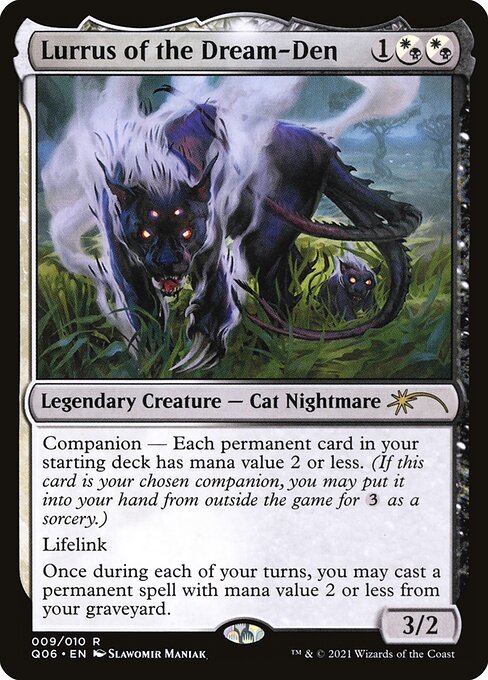
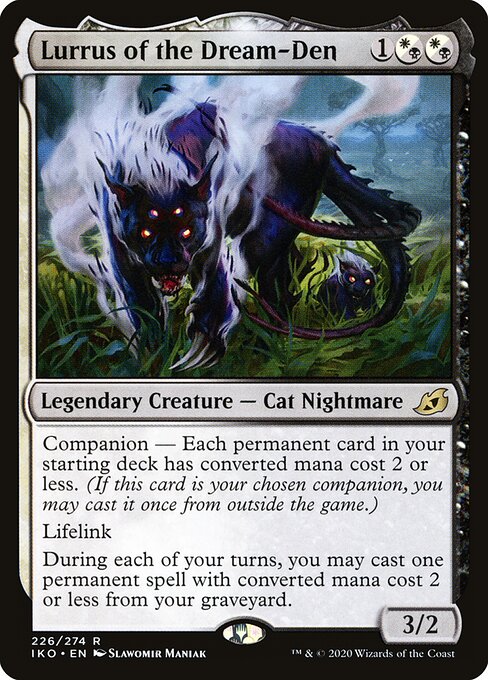
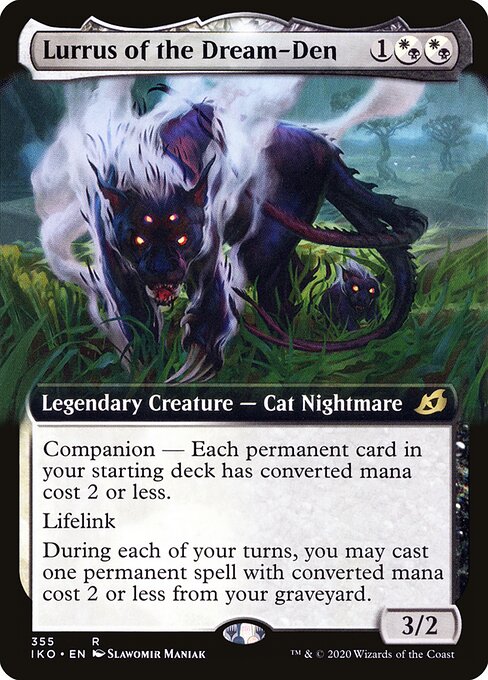
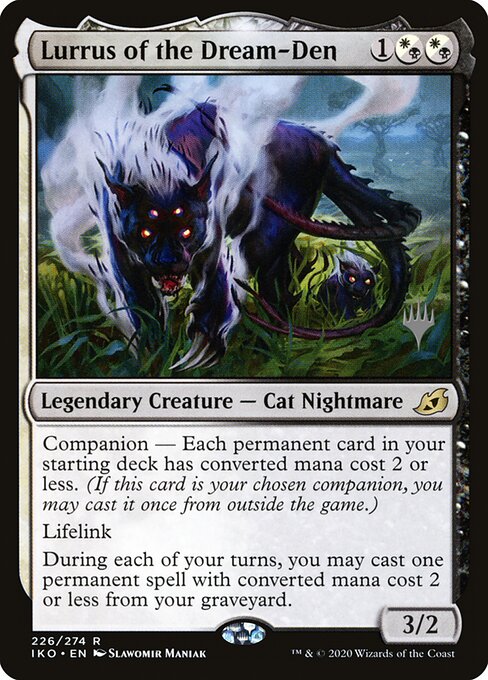
Autres impressions de cette carte
De la plus récente à la plus ancienne · illustrations et variantes incluses.
Historique des prix indicatifs
Prix indicatifs Scryfall de cette impression. EUR et USD représentent des marchés différents, sans conversion. Les dates reflètent les relevés réellement enregistrés.
Afficher les relevés accessibles
| Date du relevé | Finition | Prix |
|---|
Combos liés à cette carte
Combinaisons issues de Commander Spellbook. Les prérequis, la légalité du format et la situation de jeu restent à vérifier. Les textes source des conditions sont en anglais.